
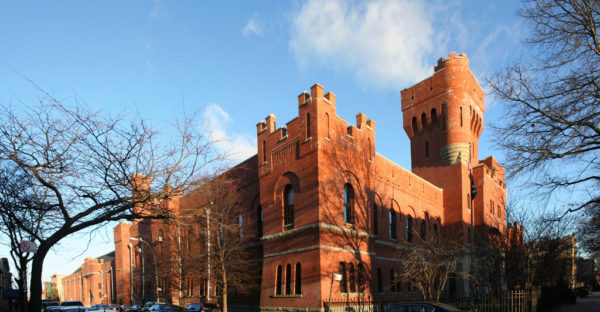
Fourteenth Regiment Armory

Designated April 14, 1998 Built in 1891-95, the Fourteenth Regiment Armory is designed in the castellated style by William A. Mundell. The armory consists of a three-story administration building with asymmetrical three- and four-story towers and corner bastions facing Eighth Avenue, and a one-and-one-half-story, barrel-vaulted drill shed with shallow buttresses and projecting entrance pavilions on […]
Forty-Sixth Street Theater

This theater’s design in the “stadium” plan was an innovation that reflected a concern for the democratization of the theater-going experience. It is a fine example of the Adamesque design, and its significant architectural features include its domed ceiling, and the Adamesque plasterwork on its proscenium arch, boxes, balcony front, and sounding board arch.

First Precinct Police Station

The First Precinct Police Station is a public building, designed in the striking neo-Italian Renaissance style. In its massive scale and restrained ornamentation the building creates an imposing effect. It stands in an area of the city which is particularly rich in early history.

Fleming Smith Warehouse

Among its important qualities, the Fleming Smith Warehouse is an architecturally distinguished commercial structure, that it was designed by Stephen Decatur Hatch, a notable New York City architect. The building displays handsome neo-Flemish and Romanesque Revival features such as the striking gabled roof and round-arched windows. The building’s picturesque silhouette complements its architectural character.

Forward Building

The Forward Building, a ten-story Beaux-Arts style skyscraper completed in 1912, is a major early work of architect George A. Boehn whose nearly fifty-year practice was distinguished by designs for public buildings in New York City and  Westchester. The ten-story Forward Building remains to this day a towering presence within the context of its immediate […]

First Houses

Among its important qualities, the First Houses is both historically and architecturally significant. It was the first public, low-income housing project in the nation. It was the first project undertaken by the newly established New York City Authority. It was the first municipally sponsored and operated project which endeavored to deal with housing problems of […]

First German Baptist Church

The First German Baptist Church, erected in 1866-69 to the designs of Julius Boekel, is a significant reminder of the evolving character of the Lower East Side and an excellent example of the Rundbogenstil style of architecture. The building’s Rundbogenstil design incorporates such typical German Romanesque features as roughly coursed stone facings, large round-arched openings, […]

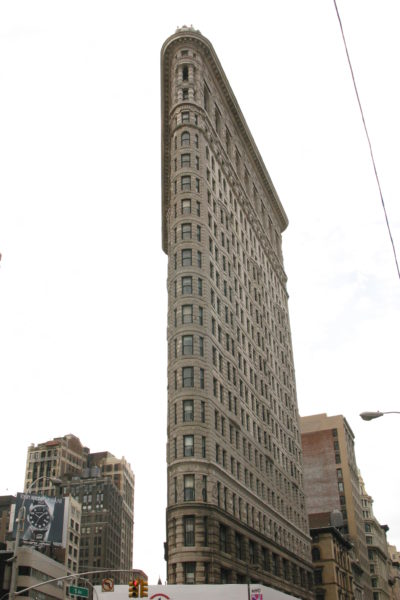
Flatiron Building

Designated: September 20, 1966 The Flatiron Building is an example of the early steel-framed skyscraper built on an unusual triangular site. Due to the prow-like effect of its northern end, it creates an impression of great slenderness and height. It displays a wealth of ornamental detail representative of its time and that although a utilitarian office […]

F.W.I.L. Lundy Brothers Restaurant Building

Designated March 3, 1992  Constructed in 1934 for restaurateur Frederick William Irving Lundy, in conjunction with the government-sponsored redevelopment of the Sheepshead Bay waterfront in the mid-1930s, Lundy’s was thought to be one of the largest restaurants in the country when it was completed and remains among the largest restaurant buildings in Brooklyn. The Lundy […]