
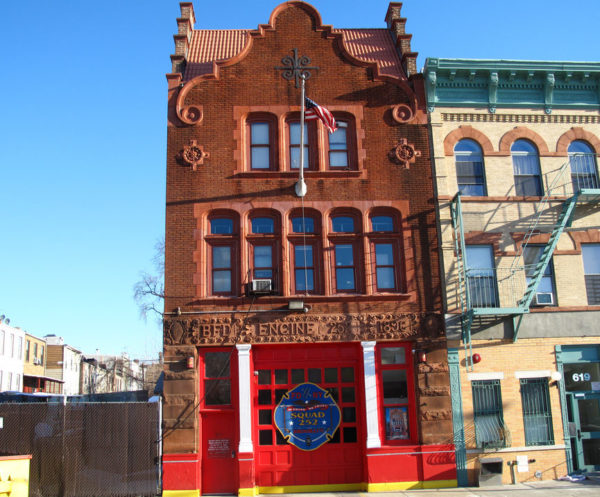
Engine Company 252

Designated October 19, 1995 Engine Company 252, built in 1896-97 for the City of Brooklyn, is a major design by the prominent Brooklyn architectural firm of Parfitt Brothers. The design of the firehouse, a Flemish Revival style structure with a prominent scrolled front gable and stepped end gables, may allude to the seventeenth-century history of […]

Empire Building

The Empire Building is considered one of the finest of the surviving late-nineteenth-century office towers in New York City, and is also significant as one of the earliest, as well as one of the earliest extant, steel skeletal-frame curtain-wall skyscrapers set on pneumatic caissons in the city. The building, originally 20 stories (plus basement) and […]

Equitable Building

On its completion in 1915, the Equitable Building was the largest office building in the world, an H-shaped superstructure above a six-story base, rising approximately 38 stories straight up from the lot-line. It has an elegant Beaux-Arts ornamental treatment that emphasizes Roman classical detail at the base and top. All four facades have a tripartite […]

Emigrant Industrial Savings Bank Building

The Emigrant Industrial Savings Bank, established in 1850, was an important aid to Irish immigrants settling in New York during the second half of the 19th century. This building, the third for the institution on the same site, was designed by Raymond Almirall, a noted New York architect. Almirall’s Beaux-Arts style design represents an important […]

Eldridge Street Synagogue

Among its important qualities, the Eldridge Street Synagogue is one of the very first buildings on the Lower East Side built specifically as a synagogue, and the first and finest synagogue built for the Orthodox East European Ashkenazic community. Its architects, the Herter Brothers, were prominent in construction on the Lower East Side. Its imposing […]

Eleventh Street Methodist Episcopal Chapel

Gothic Revival style features of the church include the window hood moldings with stops and the pointed finials at the roof. The squares with stylized flower designs and the pointed arched corbel table of the cornice are decorative, eclectic features that are highly unusual.

Everett Building

Built in 1908 for the Everett Investing Company, was designed by Goldwin Starrett & Van Vleck, a firm known for its commercial architecture. In its design, the Everett Building synthesizes classical elements with key aspects of both the New York and the Chicago styles. Goldwin Starrett, the architect, brought to his New York practice a […]

Eleventh District Municipal Court/Seventh District Magistrates’ Court

This building is one of the few remaining nineteenth-century public buildings in the western portion of Midtown, and one of only three district courthouse buildings of that era extant in Manhattan. The courthouse demonstrates John Duncan’s  ability to skillfully employ the Renaissance Revival style in a small civic structure. The iconography of the terra-cotta detailing, […]

Engineers’ Club Building

The Engineers’ Club Building is an early example of the high-rise clubhouse building. It featured 66 sleeping rooms, in addition to public and social spaces. The Engineers’ Club occupied the West 40th Street building until 1979, when the structure was successfully converted into residential apartments. Today the Engineers’ Club Building looks almost exactly as it […]

Emily Trevor House

This charming neo-Federal house was built in 1927-28 and designed by architect Mott B. Schmidt. Schmidt had also used this popular style several years earlier in the Sutton Place development. The area in which the house is located acquired the name “Carnegie Hill” soon after Andrew Carnegie erected his mansion at Fifth Avenue and 91st […]