James F. D. and Harriet Lanier Residence

This imposing residence of Beaux-Arts design was built in 1901-03 for James and Harriet Lanier in the fashionable Murray Hill section of New York. Designed by the architectural firm of Hoppin & Koen, it remains one of their finest residential works in New York City. Among its significant features are the rusticated ground floor base, […]

James Hampden Robb and Cornelia Van Rennselaer Robb House

This elegant and imposing structure is considered one of the finest urban residences designed by Stanford White of the prominent architectural firm of McKim, Mead & White and was one of the earliest Renaissance Revival townhouses by White. Articulated by White with an exceptional command of proportion and design, the building is composed with simple […]

Grand Central Terminal – Exterior and Interior

Grand Central Station, one of the great buildings of America, evokes a spirit that is unique in this City. It combines distinguished architecture with a brilliant engineering solution, wedded to one of the most fabulous railroad terminals of our time. Monumental in scale, this great building functions as well today as it did when built. […]

George S. Bowdoin Stable

This two-story stable building was constructed in 1902 for William R. H. Martin, a businessman and real estate developer active in the Murray Hill section of the city. Architect Ralph S. Townsend designed this small building in a distinctive Dutch Revival style, with an elaborate stepped gable and oversized stone quoins and voussoirs.

Ford Foundation Building – Exterior and Interior

The Ford Foundation and its architects, through this new building, offered New York an alternative model for a modern office building, creating an elegant, transparent glass cube enclosing a twelve-story high, lush, indoor landscaped atrium visible from outside. The architects, in an approach unusual for modern movement buildings in the 1960s, carefully considered the context […]

Engineers’ Club Building

The Engineers’ Club Building is an early example of the high-rise clubhouse building. It featured 66 sleeping rooms, in addition to public and social spaces. The Engineers’ Club occupied the West 40th Street building until 1979, when the structure was successfully converted into residential apartments. Today the Engineers’ Club Building looks almost exactly as it […]

Della Robbia Bar

Designated: April 5, 1994 Built in the beginnings of the Nineteenth Century, it retains its trim of colorful, glazed architectural terra-cotta, and its salt-glazed ceramic tiles formed into a technologically significant vaulted ceiling. The Della Robbia Bar exemplifies the spacious public interiors incorporated into hotels built during the decade before World War I.  It is a […]

Daily News Building – Exterior and Interior

Designated 7/28/1981 The lobby is a composite creation, incorporating an original circular space. In Raymond Hood’s original design, the lobby was conceived as a darkly lit circular space, rising to a hemispherical dome of faceted black glass, suggesting the black of space, surrounding an enormous globe, partially sunk beneath floor level, representing the planet earth. The […]

Civic Club

Desiganted 3/28/1978 The elegant building of the Civic Club, now known as Estonian House, was designed in the French Beaux-Arts style by Thomas A. Gray. Erected in 1898-99, the Civic Club building was commissioned by Frederick Norton Goddard (1861-1905), the founder of the club and a leading social reformer in the city.

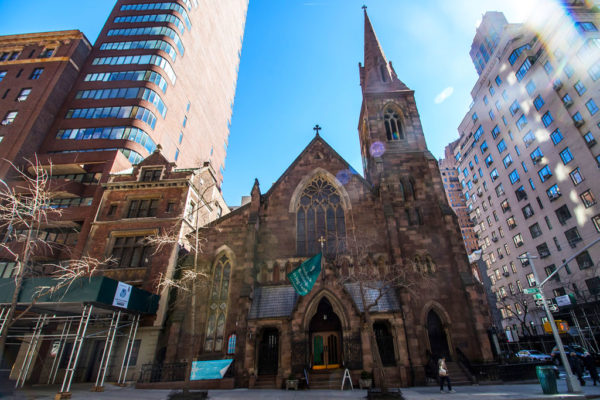
Church of the Incarnation and Rectory

Designated 9/11/1979 The Church of the Incarnation and Parish House form a  striking complex in the Murray Hill area. The church, designed by Emlen T. Littell and built in 1864, is a significant example of Gothic Revival architecture, and  among its notable features are the corner tower, the entrance porch, the carefully executed pointed-arch openings with […]