

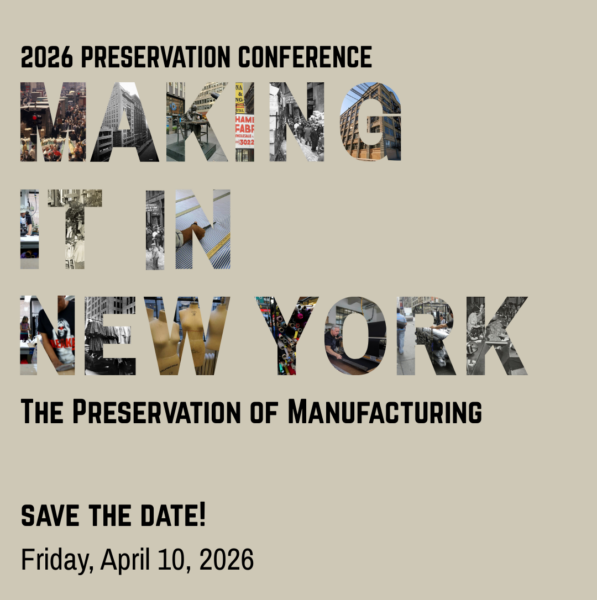
1:00 p.m. – 6:30 p.m.
Baruch College, 151 East 25th Street, New York, NY 10010
3LU
Manufacturing has long been an integral part of New York City’s success, with businesses, makers, suppliers, and many others creating a rich network that provides for the city and world. From the Garment District to historic industries lining the New York Waterfront, these places imbue neighborhoods with an irreplaceable character while also providing crucial jobs and goods. But today, manufacturing feels squeezed between a growing call for more housing, vastly increased real estate prices, and the slow loss of industries to other places. What is the preservation community’s role in preserving manufacturing, both the historic places that many of these industries inhabit, as well as the industries themselves?
HDC’s 2026 Conference will examine this complex topic with discussions among legacy businesses, new makers and artisans, economic development officials, historians, architects, developers, and many other stakeholders.
View the Program
Conference Tour Series:
Brooklyn Army Terminal Tour – April 18
Brooklyn Navy Yard: Past, Present & Future – May 16
Immigrants, Industry, and Style: A Garment District Tour – May 26
Conference Panels
1:00 PM: Event begins, doors open
1:15 PM Welcome Remarks
1:30 PM: Panel 1
2:45 PM: 10-Minute Break
3:00 PM: Panel 2
4:15 PM: Panel 3
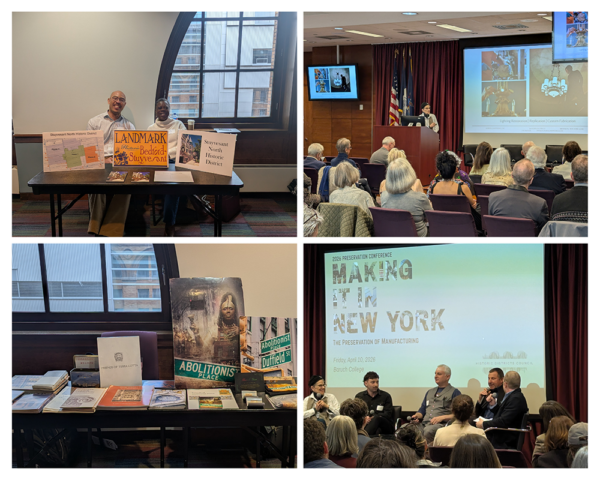
5:30 PM: Preservation Fair and Reception
6:30 PM: Preservation Fair and Reception ends
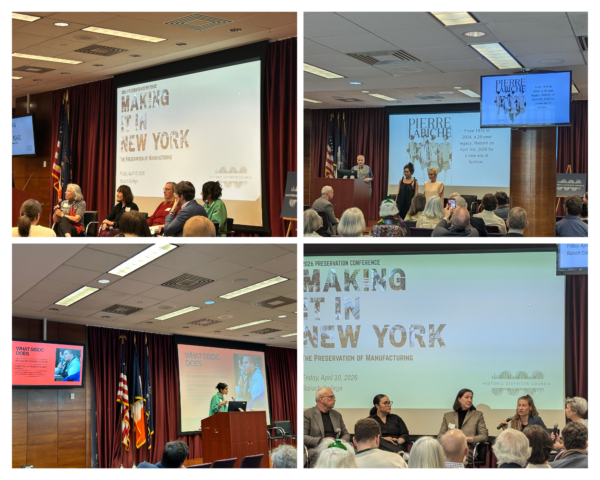
Panel 1: Practitioners and Community
Jeffrey Spring, President, Modern Art Foundry
Dawn Ladd, Principal, Aurora Lampworks
George Kalajian, Owner, Tom’s Sons International Pleating
JP Coyle, Partner, WORKSPACE11
Moderated by: Ben Dreith
Who is doing the work of advocating for industries and individual businesses, especially in neighborhoods where manufacturing has historically been an anchor? This panel features current manufacturers who will discuss how things work currently including some of the battles they’ve faced to preserve their communities and their businesses.
Panel 2: Developers and LDCs
Mary Habstritt, President, Roebling Chapter, Society for Industrial Archeology
Micaela Skoknic, Director of Development & Communications, Southwest Brooklyn Industrial Development Corporation
Cassandra Smith, Senior Project Manager, Greenpoint Manufacturing and Design Center
Nina Rappaport, Steering Committee Member, Western Queens Community Land Trust / Vertical Urban Factory
Moderated by: Ian Volner
How has industry survived and thrived in New York City and what role have historic industrial buildings played? This panel will feature voices who have successfully created spaces where businesses continue to make things. What obstacles have they faced and how have they rehabbed historic structures to continue providing a nucleus for manufacturing and makers?
Panel 3: The Future?
Jennifer Gutierrez, Council Member for New York City’s 34th District
Carly Baker-Rice, Executive Director, Red Hook Business Alliance
Tessa Maffucci, Coordinator, New York Fashion Workforce Development Coalition / Assistant Chair, Pratt Fashion Department, Pratt Institute
Rick Cook, Founding Partner, COOKFOX Architects
Our final panel will be a wide-ranging conversation on the future of manufacturing in New York City and preservation’s role. What role does nostalgia play in preserving these places? Should adaptive reuse of industrial buildings for new uses be considered a win? In an ideal world, what do we need to have industry thrive in historic locations?
Moderated by: Karrie Jacobs
AIA Credit $50; General $35
Friends / Seniors $25
Students Free
SOLD OUT

Become a Conference Co-Sponsor!
As we prepare for our annual Preservation Conference, we are in search of individual and organizational Co-Sponsors. In addition to admission, your sponsorship will include recognition on the HDC website and all other promotional materials, acknowledgement at the event, and a table to feature your company or organization’s work to attendees at the 2026 Preservation Fair. To learn more about our Co-Sponsor packages, continue reading below.
Non-Profit and Community Organizations $0 -SOLD OUT
Includes co-sponsor listing on the HDC website and a complimentary table to share your organization and its work with attendees at the 2026 Preservation Fair. Space is limited, reserve today!
Professional Partner $500
Includes 4 tickets to the event, co-sponsor listing on all digital and printed advertising materials, the opportunity to feature your company’s materials at the preservation fair, and invitations to future HDC events.
Preservation Leader $1000
Includes 8 tickets to the event, co-sponsor banner listing on all digital and printed advertising materials, the opportunity to feature your company’s materials at the preservation fair, invitations to future HDC events, and a special invite to a tour and reception held by HDC for up to 5 guests.
Community, preservation, and manufacturing-related organizations and companies are encouraged to register. If you or your organization is interested in participating as a Non-Profit or Community Organization at the 2026 Preservation Fair, please contact Michelle Arbulu at [email protected] with your organization’s name and contact information. The Preservation Fair will be held after the confernce during the reception.
If you or your organization is interested in the Professional Partner or Preservation Leader packages, please register here. If you have any questions, feel free to contact Kaija Mendez-Bryan at [email protected].
We hope to see you there!
Panelists Bios:
Jeffrey Spring is third generation owner of Modern Art Foundry. Established in 1932 by his grandfather John Spring. In 1993 Jeffrey joined his father Bob Spring (1932-2020) who had started working in 1955, and his sister Mary Jo. He began running the day to day operations around 2000. Modern Art Foundry’s long standing tradition and reputation for high quality continues into its 94th year of operations. Jeffrey’s thirty plus years of hands on experience in the art casting business, with unique daily interactions with artists and the art community. Modern Art Foundry specialized in providing sculpture services, with a focus on bronze casting, sculpture conservation, and commemorative design work.
Aurora Lampworks was started by its principal, Dawn Ladd, in New Haven, CT. It began as a lighting showroom where antique fixtures were restored and offered for sale. Located in Brooklyn since 1990, this year marks its 45th year in business. Over the many years, the company has grown and earned an outstanding reputation in the lighting industry. Aurora has a network of designers, artisans, blacksmiths, conservators, glassmakers, and finishers to handle the huge diversity of materials used in the fabrication and restoration of lighting fixtures. Regardless of style, period or material, Aurora is prepared with appropriate techniques and exemplary craftspeople to complete the scope of work. Making lighting fixtures meant to last is an important part of a conservation ethic we live and work by.
George Kalajian is a master craftsman and owner of Tom’s Sons International Pleating, a family business in New York City’s Garment District with over 150 years of heritage. His expertise in pleating has made him a trusted collaborator for iconic fashion brands like Oscar de la Renta, Coach, Vera Wang and Ralph Lauren, as well as major productions like the MET Gala and Hollywood films. Co-author of Pleating: Fundamentals for Fashion Design, George carries on the legacy of his father, Leon, ensuring that the art of pleating continues to inspire and evolve.
JP Coyle is a partner at Workspace11, a Brooklyn-based architectural metal and sculpture fabrication studio that works with artists, architects, and cultural institutions to realize complex large-scale works. Working closely with artist Norman Mooney, he helps lead the development and production of projects that merge contemporary sculpture with architectural fabrication.
JP has been with the studio for nearly six years and helped guide its transition into Powerhouse Arts in Gowanus, a major adaptive reuse of a historic power station into a center for fabrication and the arts. During that time he has experienced firsthand the pressures facing industrial businesses in New York, joining the studio during its move to Gowanus and ultimately to Powerhouse Arts as manufacturing space continued to disappear across Brooklyn’s historic industrial districts.
He has also collaborated with the Southwest Brooklyn Industrial Development Corporation (SBIDC) on initiatives supporting industrial business development and retention in Brooklyn’s manufacturing zones.
Ian Volner has contributed articles on architecture, design, and urbanism to The New York Times, The Wall Street Journal, The New Yorker, and Harper’s among other publications, and is a contributing editor at Architecture Today (UK). He is the author of numerous books and monographs, most recently Jorge Pardo: Public Projects and Commissions (Phaidon, 2021).
Mary Habstritt has been Museum Director at Lilac Preservation Project since 2009, overseeing interpretation and restoration of a 93-year-old steam-powered former Coast Guard Cutter. She previously worked as a freelance historical consultant researching, interpreting and advocating for industrial and maritime sites. Mary is the 2025 recipient of the Society for Industrial Archeology’s General Tools Award for Contributions to Industrial Archeology. She recently became President of SIA’s Roebling Chapter for the second time, promoting the study of industrial heritage in New York and New Jersey. Her devotion to history and preservation follows a career as an academic librarian.
Micaela Skoknic is Director of Development & Communications at the Southwest Brooklyn Industrial Development Corporation (SBIDC), where she leads fundraising, partnerships, and communications to preserve and strengthen New York City’s local manufacturing economies. A civic and cultural strategist, she is drawn to working waterfronts and industrial districts as liminal landscapes—places where nature, infrastructure, and production hold each other in balance.
Her background includes work as an environmental attorney in Chile, fellowships at the Pratt Center for Community Development and World Monuments Fund and cultural stewardship with the DIY collective 8 Ball Community. She brings a cultural perspective to questions of industrial preservation, exploring how historic spaces continue to support production, creativity, and community life. She is also a musician and artist. Micaela holds an M.S. in Historic Preservation from Pratt Institute and a law degree from the Universidad de Chile.
Cassandra Smith, Senior Project Manager, Greenpoint Manufacturing and Design Center (GMDC) Cassandra Smith is a planner and preservationist who leads the team that manages real estate development and planning projects for GMDC, a non-profit real estate developer of space for small manufacturing businesses. Cassandra joined GMDC in the summer of 2006 and has since played a critical role in the development of projects that utilize a variety of tax credits and City, State, and Federal incentive programs. Before joining GMDC, she worked with community organizers at Partnerships for Parks, a jointly funded program of the City of New York Department of Parks and Recreation and the City Parks Foundation, and as an AmeriCorps intern at Habitat for Humanity in both New York City and Oakland, CA. She holds a BA from Mills College and Masters’ Degrees in Urban Planning and Historic Preservation from Columbia University’s GSAP.
Nina Rappaport is an urbanist, architectural historian, and educator. She directs Vertical Urban Factory, focusing on the intersection of production spaces, architecture, and the role of the factory worker. She is the author of Vertical Urban Factory (Actar 2015, paperback 2020) and curated the eponymous international traveling exhibition (2011–24). She co-edited Design for Urban Manufacturing (Routledge 2020) and organized the conference Hybrid Factory/Hybrid City at Politecnico di Torino and the book of the same name (Actar 2023). She convened the symposium Hybrid Urban Factory at Yale in November 2023.
She is Publications Director at the Yale School of Architecture, where she edited the magazine Constructs for 24 years and continues to run the book and catalog production. She teaches at Kean University School of Public Architecture, where she co-founded the Center for Urban Industry.
She is a founder of Docomomo US and Docomomo New York/Tri-State, where she is a Vice President. She is a member of the Steering Committee of the Western Queens Community Land Trust, the Program Committee of the Design Trust for Public Space.
She has written numerous essays for international journals on the topic of the productive city and lecturers internationally.
Jennifer Gutiérrez is a community organizer, mother of two, and Council Member for New York City’s 34th District, covering parts of Bushwick, Greenpoint, Williamsburg, and Ridgewood. Born in Queens to Colombian immigrants, she is the first Colombian-American on the City Council. Gutiérrez has become a leader on key issues like tech equity, universal child care, maternal health, and pioneering protections for manufacturing businesses.
Carly Baker-Rice is Executive Director of Red Hook Business Alliance, which supports businesses, nonprofits, artists, freelancers, and home-based businesses in NYC’s favorite mixed-industry, working waterfront community. Through an NYC Small Business Services grant, she delivered the City’s first Commercial District Needs Assessment to deal with a mixed-industry neighborhood and currently oversees the 3-year Neighborhood 360 grant based on those findings. She led RHBA’s on-the-ground emergency response role, supported federal disaster declaration, and continues to support recovery after the September 17, 2025 fire destroyed 180,000sf of light manufacturing space and a January 21, 2026 warehouse fire displaced another 10 businesses.
For more than a decade before that, she served as lead consultant to government, nonprofits, and 100+ businesses from all sectors to design workplace learning and improve outcomes through interventions designed collaboratively from top down and ground up.
Tessa Maffucci is a teacher, researcher and organizer advocating for ethical fashion economies. She teaches fashion history and theory focusing on the intersections of fashion and labor, with an emphasis on sustainability, technology and material culture. She has taught at Parsons School of Design and Pratt Institute, where she is currently the Assistant Chair of the Fashion Department. She coordinates the New York Fashion Workforce Development Coalition (NYFWDC), an advocacy collaborative of New York’s fashion community, including manufacturers and designers in the Garment District. Tessa is a recipient of the Made in NYC Fellowship and has written for publications including Architectural Digest, Bloomsbury Fashion and The Fashion Studies Journal.
Rick Cook is the Founding Partner of COOKFOX Architects, a New York–based studio dedicated to high-performance, environmentally responsive design. Over the past 40 years of practice, he has built a reputation for innovative, award-winning architectural design.
Before co-founding COOKFOX in 2003, Rick led Richard Cook & Associates, building a diverse portfolio that included adaptive reuse projects including The Atalanta and Historic Front Street, and significant projects in historic districts, such as The Caroline and Chelsea Grande. At COOKFOX, he has become a leading expert on high-performance design projects. His portfolio includes workplace buildings One Bryant Park and 512 West 22nd Street; and reimagined structures including St. John’s Terminal that transformed a historic rail terminal into a new home for Google, the historic Terminal Warehouse, and 555 Greenwich that was designed as an extension to the historic printing house at 345 Hudson and is now one of New York’s most energy efficient new workspace buildings.
His work also includes the Stephen Sondheim Theatre, Marymount School’s new 97th Street campus, supportive housing in the Bronx, and the Bruce Springsteen Center for American Music. Rick co-founded Terrapin Bright Green and is a member of the Design for Freedom Working Group, advancing supply chain equity in the built environment.
Thank you to our Co-sponsors
(this is a running list)
Non-Profit and Community Organizations
ReThread Project
Hart Island Project
Victorian Society of NY
Urbanist Media
Friends of Abolitionist Place
Friends of Terra Cotta
Preservation League of Staten Island
Local Development Corporation of East New York
UrbanView Group
The First Chinese Presbyterian Church
Paul Rudolph Institute For Modern Architecture
Professional Partner
FRIENDS of the Upper East Side
Jenkins Architecture PLLC
Modulightor Inc
Municipal Art Society
Preservation Leader
AIA New York | Center for Architecture
John M Bacon
Françoise Astorg Bollack
Greenpoint Manufacturing and Design Center